On the morning of 11 September 2009, I had no idea I’d soon be searching for faith after spinal cord injury. Here’s what I posted on Facebook that morning, hours before everything changed:
In a universe vast and unending, captured by the Hubble Space Telescope, the beauty of the Butterfly Nebula now appeared on my Facebook page. The tribute to God’s majesty was interrupted by an earthly reality — I was running late for Cedar College’s Sports Day.
Life was about being married, raising a young family and an IT career. This particular Friday, I took off work to support my children.
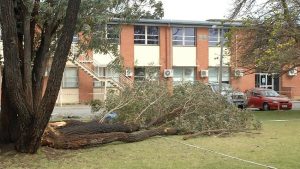
By that afternoon, a falling tree branch had caused a spinal cord injury that left me lying on the ground, paralysed. That’s when faith became relevant — and I discovered mine wasn’t much to draw on.
What Weak Faith Looked Like After a Spinal Cord Injury
I didn’t have a crisis of faith when the branch came down. I didn’t have much faith to lose. What I had was a habit — the kind you inherit rather than build — thin, occasional, untested.
In the early days in ICU, that lack of faith showed. I wasn’t angry at God. I wasn’t especially hopeful either. Mostly I was just present, the way you’re present in an elevator: not thinking too much about it, only noting how many times the door opens and closes before you reach your floor.
If you’d asked me then whether I believed God was with me, the honest answer would have been something like, “I’m still working it out.” Not a confession of doubt. Just the truth.
Prayer and Faith After Spinal Cord Injury: The Prayers That Didn’t Sound Like Prayers
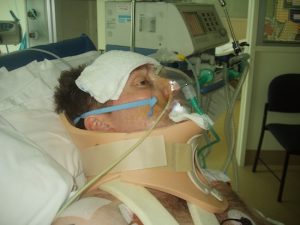
In ICU, alarms went off in other rooms as often as mine, and lying still, I couldn’t always tell whether I was overhearing someone recovering or someone dying. It was Dad who gave it something else to do instead.
He’d sit beside the bed and get me counting — chairs in the room, ceiling tiles, whatever was there. It didn’t mean anything. That was the point. It was a small, deliberate discipline against a mind with nowhere good to go.
When I wasn’t counting, I’d pray. Plain, unpolished, more habit than theology. Not eloquent. Not even especially hopeful.
My kids were praying too, in their own way — handwritten notes, a chain-letter prayer request passed between school friends. I didn’t have the strength to lead a faith conversation with them; besides, I couldn’t talk.
Why ‘Everything Happens for a Reason’ Never Sat Right
People say it kindly. I understand why. But it’s never been true to my experience, and I ceased pretending otherwise a long time ago.
A branch falling on a specific afternoon didn’t happen for a reason I can name. It happened. What came after — the rehabilitation, the institutions, the family strain, the slow rebuilding — that’s where meaning had to be built, not found ready-made.
That distinction matters to me. I’m not writing a book about a God who engineered my suffering for a lesson. He didn’t cause or want the accident to occur. I’m writing about what it took to keep believing anything at all while living through it — and what gradually changed in how I carried the hard days once I did.
How My Faith After Spinal Cord Injury Actually Changed, Over Years Not Days
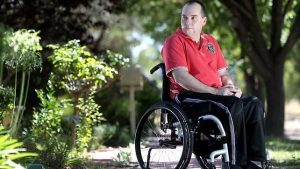
If you’re waiting for the part where I tell you my faith became certain, that’s not this story. It didn’t happen that fast, and it didn’t happen once.
There was a stretch, a couple of years in, where I’d have described my faith as close to a void. Church attendance stopped. Prayer thinned out to almost nothing. I don’t think that surprises anyone who’s lived through something long and grinding. Crisis faith runs hot for a while, then it runs out.
What brought it back wasn’t a single moment. It was small behaviours, repeated a few times. A verse that suddenly read differently than it had for years, or a night where prayer was the only thing left to do, even when nothing about the situation was likely to change, or a willingness to sit with a hard question instead of needing it answered before I’d trust again.
Somewhere in there, trust stopped meaning “this will turn out how I want” and started meaning something closer to “I’m cared for regardless of how this turns out.”
These days, faith shows up less as crisis prayer and more as ordinary practice — less about what I’m praying for next, more about what I do with what I’ve already been given. Giving has become part of that: a small, steady commitment that has nothing to do with my own recovery and everything to do with what gratitude looks like once it’s had years to settle.
I still don’t have all the answers. I’ve stopped needing them. What I have instead is a pattern I’ve come to trust — not because every prayer was answered the way I wanted, but because, looking back over enough years, I can see more of a hand in it than I could ever have proven at the time.
About the book
Alive and Not Kicking is my memoir — the story of what happened before, during and after 11 September 2009, when a falling tree branch left me paralysed. It’s not a story about overcoming my health issues. It’s a story about living with them: disability, chronic pain, institutional failures, family strain, humour that showed up in the worst moments, and a faith that grew slowly, through honest questions rather than easy answers.
The book is coming in mid-2027. If any of this is familiar — living with a spinal cord injury, helplessness, disappointment, a faith that’s been tested rather than confirmed — I wrote it for you.
Join the mailing list at alive-and-not-kicking.com, and I’ll send you part of the opening chapter for free, along with occasional updates and first news of the release date. No spam, ever — unsubscribe anytime.
John Duthie. (Click here for personal website and here for blogs)